Doilies for Vases: What to Know Before You Buy
A doily may seem like a small decorative detail, but when used under a vase it plays both an aesthetic and practical role. Purchasing one brings a finishing touch and helps protect your surface, but you have to keep in mind these aspects:
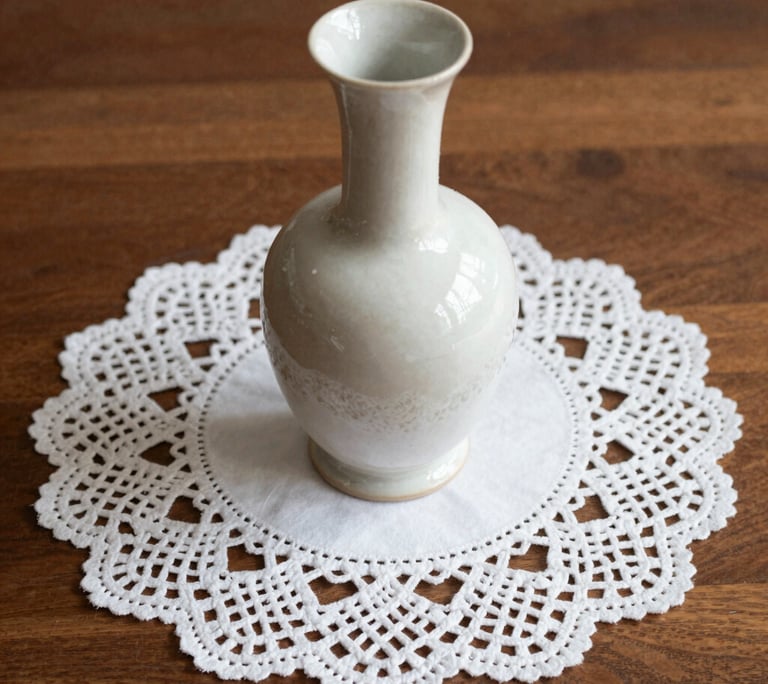
First, consider the size. The doily should be wider than the base of your vase so it creates a balanced frame around it. If it is too small or too large, it will not look visually appealing. Therefore, we recommend making sure the base of your vase is surrounded by around 10–20 cm (~4–8 inches) of doily.
The style and design should match your interior. Intricate lace doilies work well in vintage or classic spaces, while minimalist woven ones are great for Scandinavian-style interiors. You just have to match the style to the vase, whether minimalist, vintage, or another style.
Another important factor is functionality. If you have a heavier vase, choose a sturdier doily that can withstand the weight without damage.
Finally, consider the surface type where the vase will sit. Wood, glass, and marble all have different protection needs, so choose a doily that offers enough cushioning to help prevent scratches or water rings. If the surface is more sensitive, use a thicker doily and a protective pad.
Time for the verdict:
1. Size: Make sure the doily is an adequate size compared to your vase. We recommend 10–20 cm (~4–8 inches) between the vase base and the edge of the doily.
2. Style: Make sure the style matches. For example, use an intricate doily for a vintage vase, and a minimalist woven one for a modern-looking vase.
3. Functionality: If your vase is heavier, consider a thicker doily to prevent any damage.
4. Surface: People with sensitive surfaces like glass should use a thicker doily and a protective pad to prevent scratches.